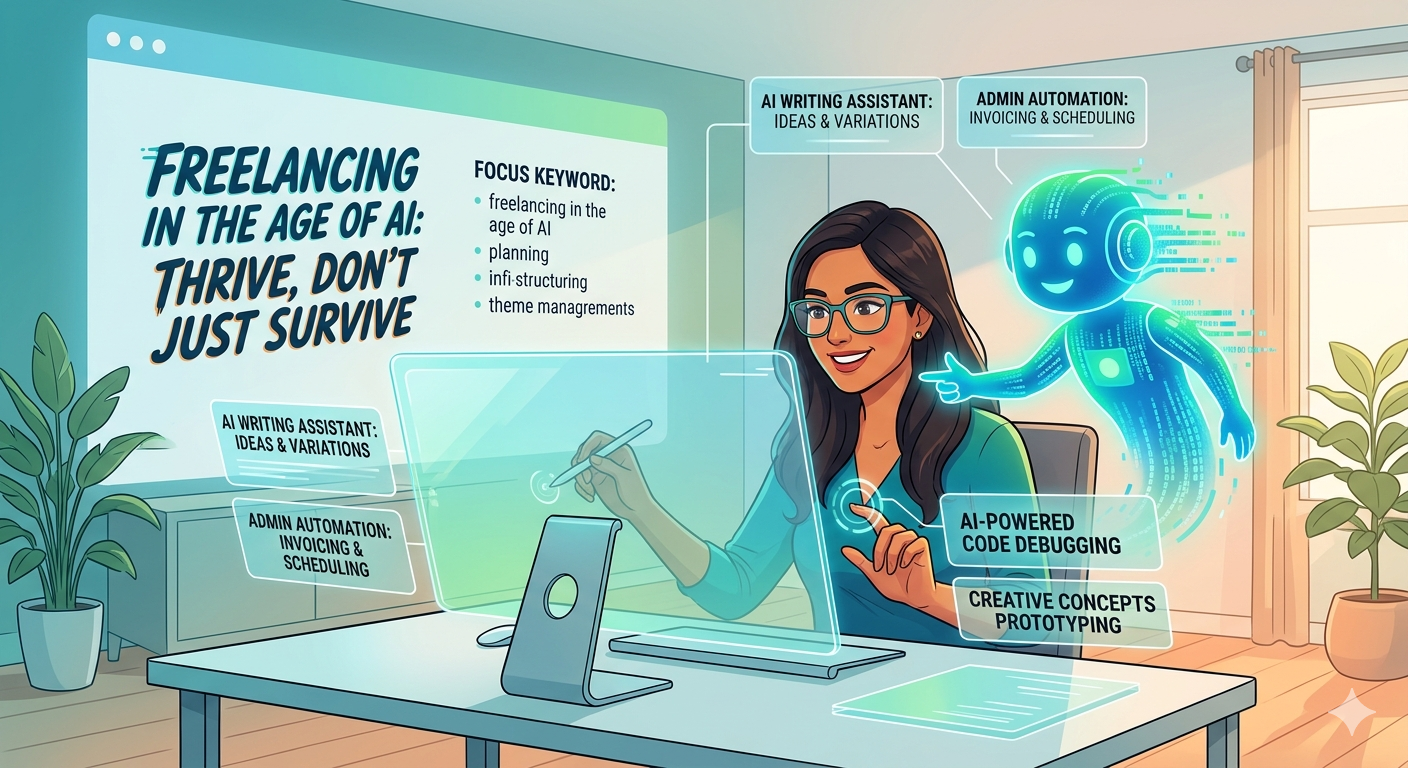
Freelancing in the age of AI has become the most talked-about shift in the modern gig economy. While the landscape is changing beneath our feet, the competitive edge for independent workers is no longer just about specialized skills—it’s about how you integrate technology. Today, Artificial Intelligence (AI) is the new variable that is both exhilarating and, for many, deeply unsettling.
You’ve seen the headlines. “AI replaces copywriters.” “Generative AI creates logos in seconds.” If you’re a freelancer, it’s natural to ask: Is my skill set becoming obsolete? Am I competing against a machine that never sleeps, doesn’t charge, and works a thousand times faster?
The answer is no, but with a crucial caveat: You are not competing against AI; you are competing against other freelancers who know how to use AI to their advantage. To succeed in freelancing in the age of AI, you must transition from a mindset of resistance to one of strategic orchestration.
Here is your roadmap for dealing with AI and turning it from a threat into your most powerful ally.
1. Embrace the Shift: How to Use AI as Your Freelance Co-Pilot
AI excels at the mundane, repetitive, and data-intensive. It is your ultimate “grunt work” delegator. Instead of fearing replacement, view AI as your eager junior assistant—one that needs guidance but can drastically amplify your output.
Speed Up Your Administrative Grunt Work
Freelancers often spend up to 40% of their time on non-billable tasks. AI can reclaim that time.
- Invoicing and Expense Tracking: Use tools that automatically generate invoices, track payments, and categorize expenses.
- Meeting Scheduling: Let AI-powered scheduling assistants handle the back-and-forth email chains to find a meeting time.
- Proposal Writing: Use generative AI to draft the core structure of a proposal, which you can then customize with your strategic insights.
Conquer Creative Block and Boost Ideation
If your job involves creativity, AI is a superb brainstorming partner.
- Content Generation: Stuck on a headline or an intro? Ask AI for 10 variations. It might not give you the perfect one, but it will shatter your writer’s block.
- Design Concepts: Designers can use image generators to rapidly prototype different styles, mood boards, or layouts before committing hours to detailed execution.
- Coding Assistance: Developers can use AI to debug code, explain complex functions, or write boilerplate snippets, allowing them to focus on software architecture and logic.
Enter New Niches and Scale Your Offerings
AI opens up new service categories that didn’t exist two years ago.
- Prompt Engineering: Clients need experts who can write effective prompts to get high-quality results from AI. This is a burgeoning new freelance niche.
- AI Content Optimization: Don’t just write; offer to optimize AI-generated drafts for tone, brand voice, factual accuracy, and human empathy.
- Workflow Automation: Use your technical skills to help businesses connect their existing tools with AI, automating their operations.
2. What AI Can’t Do: Doubling Down on Your Human Advantage
While AI is fantastic at “commoditized implementation,” it is terrible at the things that make humans indispensable. To future-proof your career, you must audit your “secret sauce” and identify the parts of your process that are hardest for a machine to replicate.
These “human-centric” skills are becoming your most valuable assets.
Deep Strategy and Problem-Solving
AI can analyze data, but it cannot set a vision. You can understand a client’s business goals, the competitive landscape, and the emotional nuances of their target audience to construct a high-level strategy that delivers real ROI.
Action Point: In your proposals, pivot from offering outputs (e.g., “5 blog posts”) to offering outcomes (e.g., “a content strategy to increase organic traffic by 20%”).
Complex Creativity and Storytelling
AI can mimic styles, but it lacks a “lived experience.” It cannot weave personal anecdotes, cultural nuance, humor, or a distinctive human voice into a narrative. Genuine storytelling that builds an emotional connection is still a purely human domain.
Action Point: Cultivate your unique style. Don’t just deliver a polished result; explain your unique creative decisions.
Emotional Intelligence and Client Relationship Management
Being a freelancer isn’t just about delivering work; it’s about solving problems and reducing stress for your clients. AI cannot manage difficult conversations, provide empathy, or build the trust that comes from a genuine human partnership.
Action Point: Focus on being a true collaborator. Check in on your clients, ask for feedback, and show that you care about their success beyond the immediate project.
Conclusion: The Future of Freelancing is Augmentation
The world isn’t divided between humans and AI; it’s divided between those who fear the future and those who build it. Freelancing in the age of AI requires continuous adaptation, strategic upskilling, and a fierce dedication to the skills that make us uniquely human.
Use AI to handle the predictable middle 80% of your work, and own the final 10% where quality control, strategy, and your unique creative touch reside. The goal isn’t to work less; it’s to work on higher-value problems.
Are you ready to stop grinding and start scaling? Embrace your new co-pilot and elevate your craft.